
Insights from Roundtable Discussion 2 at Indonesia–Japan Environment Week 2026
At the 2nd Indonesia–Japan Environment Week 2026, held on May 11–12 at the Ritz-Carlton Jakarta, Mega Kuningan, Seneca Impact Advisors contributed to discussions on advancing climate adaptation across Southeast Asia. The event brought together government agencies, companies, and international organizations from Indonesia and Japan to align policy, technology, and investment around shared environmental priorities.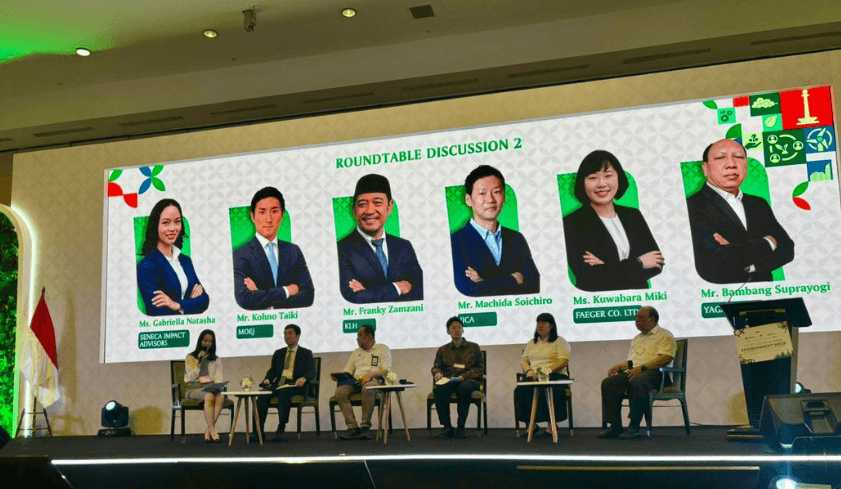
Co-organized by the Ministry of the Environment, Japan (MOEJ), the Ministry of Economy, Trade and Industry (METI), and the Ministry of Environment of Indonesia (KLH), the program combined policy dialogue, technical sessions, and business engagement to accelerate project development and cross-border collaboration.
Roundtable Discussion 2: Adapting to Climate Change
Seneca’s contribution was centered on Roundtable Discussion 2: Adapting to Climate Change, moderated by Ms. Gabriella Natasha, Investment Analyst at Seneca Impact Advisors.
The session brought together a cross-section of policy makers, development partners, and private sector actors, including Mr. KOHNO Taiki, Assistant Director, Climate Change Science and Adaptation Office, MOEJ; Mr. Franky Zamzani, Director for Climate Change Adaptation, KLH; Mr. MACHIDA Soichiro, Representative, JICA Indonesia Office; Ms. Miki Kuwabara, Project Officer, Faeger Co., Ltd.; and Mr. Bambang Suprayogi, Founder and CEO, YAGASU.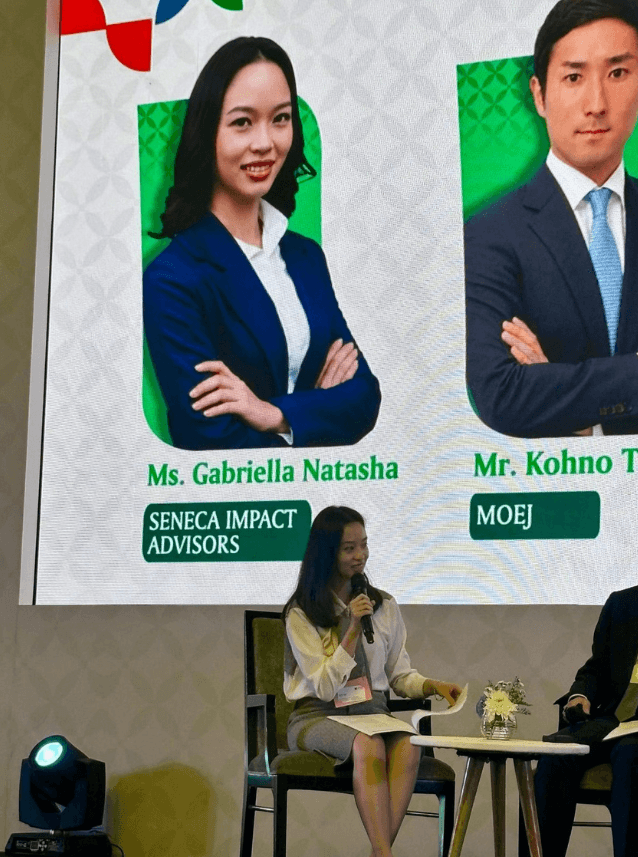
The composition of the panel reflected the structure of the challenge itself: adaptation sits at the intersection of public policy, project development, and private sector delivery.
From adaptation frameworks to implementation
Building on Seneca’s ongoing work with MOEJ across Southeast Asia, Gabriella guided the discussion toward a practical question: how to move from national adaptation strategies to a pipeline of implementable projects.
Three themes emerged from the exchange:
- Local execution remains the bottleneck
Adaptation priorities are increasingly well defined, but translating them into structured, investable projects remains uneven. - Measurement and verification are still evolving
Unlike mitigation, adaptation outcomes are harder to quantify, creating challenges for both public funding and private investment. - Financing models need to match project reality
Many adaptation interventions sit between public goods and revenue-generating infrastructure, requiring blended or hybrid financing approaches.
Positioning adaptation as a project pipeline
The discussion reinforced a consistent gap across the region: adaptation is recognized as a priority, but the pipeline of well-structured, investable projects remains limited.
For Seneca, this remains a core focus, bridging adaptation policy frameworks with project origination and capital mobilisation, particularly where nature-based solutions and infrastructure investments intersect.