A common argument against the expansion of solar energy is that solar panels can compete with or displace farmland. Indeed, some climate sceptical politicians have used this to justify efforts to restrict solar energy development.
On a surface level, this argument might appear to be warranted, given the need to increase food production for a rapidly growing global population, the high land demands of solar energy generation, and the fact that conventional solar panels are often mounted close to the ground with little space for anything else. But in fact, it need not be a case of choosing one over the other, thanks to a simple yet innovative form of land use known as agrivoltaics.
What is Agrivoltaics?
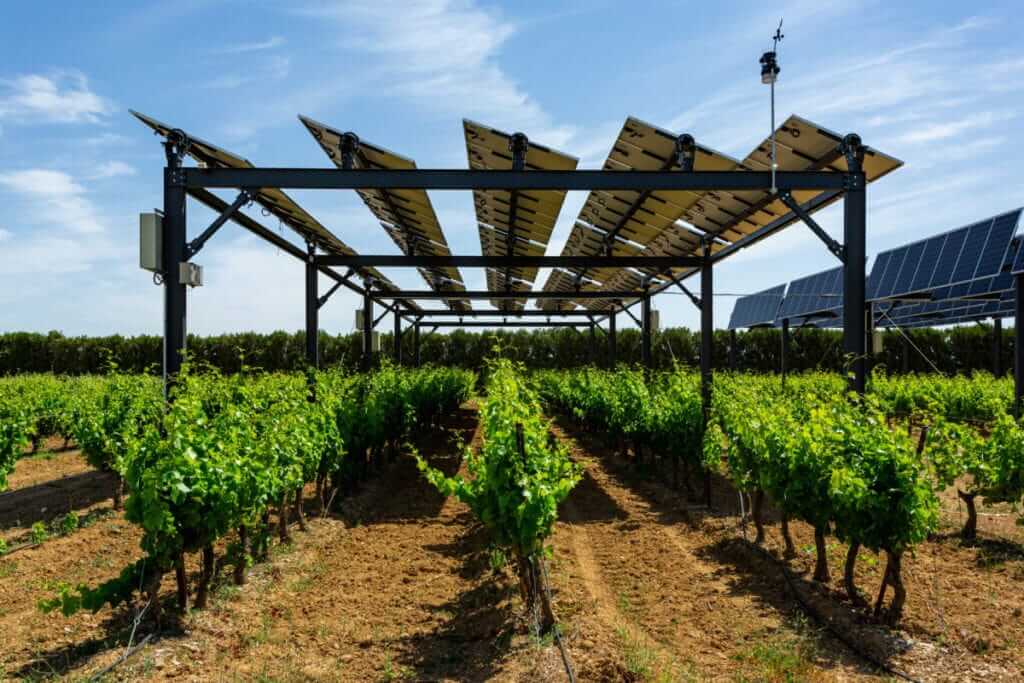
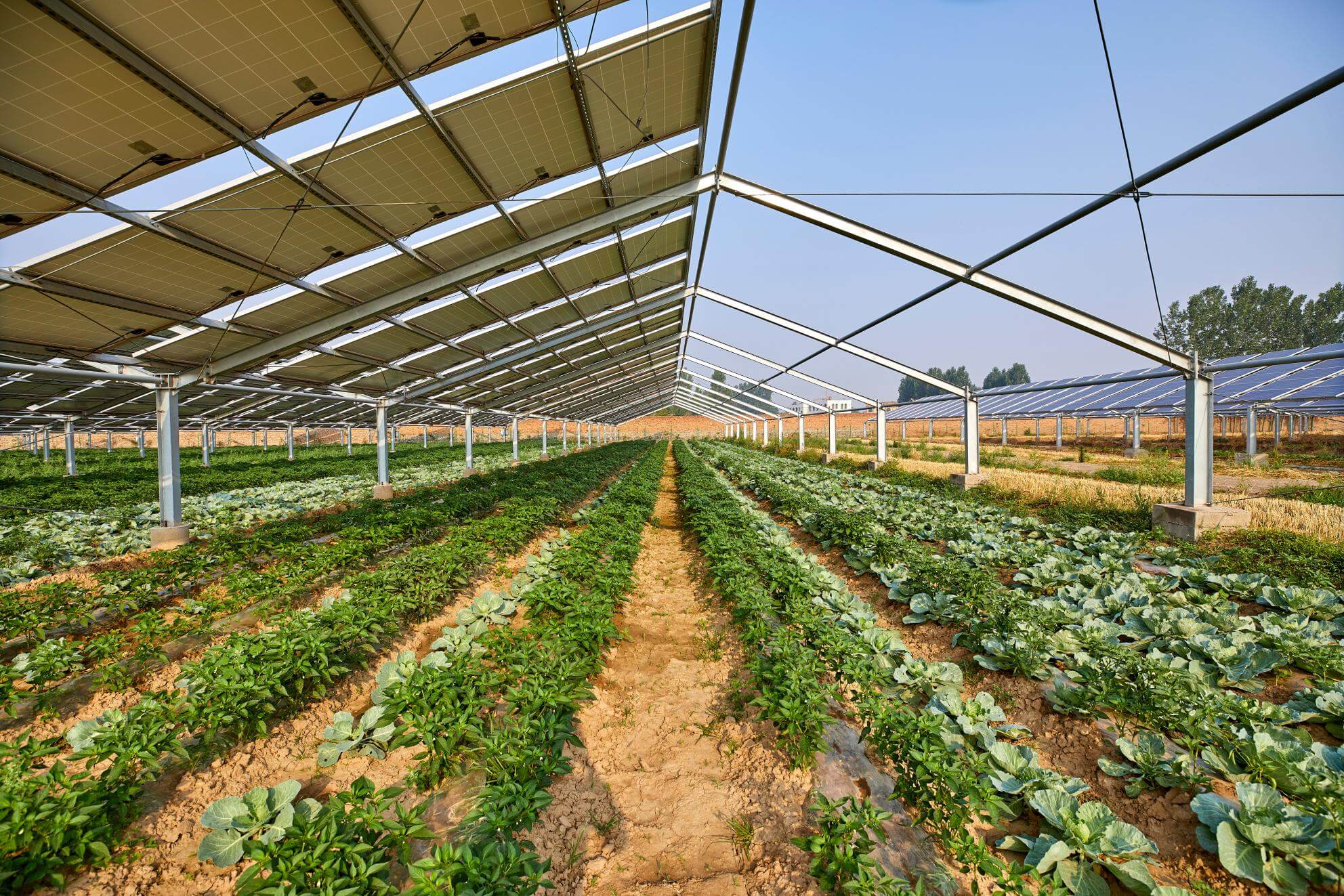
Agrivoltaics is a dual food and energy production system in which solar energy is generated on the same land as agricultural products. Panels are spaced far apart enough to allow sunlight to reach any crops below them, and the electricity they generate is used for local consumption by farmers and their communities. In many (but not all) countries, any excess electricity generated can then be sold back to the grid.
Unlike conventional solar panels, those used for agrivoltaics are often elevated high above the ground, leaving plenty of space beneath them for other types of land use. This also avoids a problem often seen in conventional solar panel installation of having to clear vegetation to make room for panels.
Not only is farming and generating solar energy on the same land physically possible; it also represents a more resilient, ecologically friendly and even financially profitable model of agriculture in an age of climate change.
Environmental Benefits
The most obvious environmental benefit of agrivoltaics –aside from avoiding carbon emissions –is not having to use so much land or destroy habitats for solar energy production. Indeed, lands formerly or already used for agriculture have been found to be better for supporting solar panels than previously undisturbed land.
Beyond this, the shading panels provide also physically protects crops and other vegetation growing beneath them from climate extremes, buffering them against both excess heat and unreliable rainfall. The cooling effect produced by shading not reduces the risk of heat damage to plants, but also allows soil to retain more water, as less is lost through evaporation.
Taking this a step further, agrivoltaics can also be used to reverse desertification, with panels both cooling the soil enough for plants to grow and acting as wind breaks to prevent topsoil from being blown away. If nitrogen fixing crops are grown under the panels, they can boost soil fertility and allow for an even wider variety of plants to grow. Such use of agrivoltaics is already being carried out in China to control the spread of the Gobi Desert, and similarly has been found to increase areas of viable agricultural land in Kenya.
Taking things further still, land used for agrivoltaics can also be used to benefit biodiversity. A subset of agrivoltaics known as eco-photovoltaics (eco-PV) involves using a portion of agricultural land to plant a variety of native wild plant species beneath and around solar panels. Studies from the UK and Minnesota have found that this leads to drastic increases in the diversity and abundance of wildflowers and insects, especially pollinators. Meanwhile, the Minnesota Habitat Friendly Solar program has reported the presence of reptiles, amphibians, birds and mammals in the created habitats of its eco-PV sites, which are also estimated to absorb 4800 metric tons of carbon per year. The biodiversity benefits of eco-PV are particularly pronounced in areas where the surrounding land has been degraded, as it provides an oasis of food and habitat for species where they would otherwise not find any.
Economic Benefits
The very things that make agrivoltaics so good for the environment also translate into considerable economic benefits for farmers and landowners. Reduced water loss means less money needs to be spent on additional water for crops, with some crops needing 20-30% less when grown under solar panels. Combined with reduced heat stress, this also allows for higher yields in many crops. Moreover, agrivoltaics causes no significant decrease in crop quality and in some cases, can even make them more visually appealing to consumers who will then be more likely to buy them. For instance, a study in South Korea found that broccoli grown under solar panels was greener than sun-grown broccoli and therefore more preferable to consumers.
Creating insect habitat alongside crops can also benefit farmers financially through free ecosystem services. In Minnesota, close proximity of insect habitat to soybean crops has been found to enhance pollination services through higher visitation by pollinating insects. Counterintuitively, pest control costs can likewise be reduced, as many insects that naturally prey on crop pests have similar habitat requirements to pollinators. Under various carbon trading schemes, planting habitats can even generate revenue itself in the form of biodiversity or carbon credits.
Then there is the direct income from excess solar energy sales. In an era of climate-related crop failures and volatile agricultural markets, this offers farmers an additional source of income that can help them to better weather shocks to their usual revenue stream (depending on the solar energy policies of the country they live in). Agrivoltaics are particularly good in this regard as solar panels have lower surface temperatures and so generate energy more efficiently when placed above vegetation; a potentially important buffer against future warming, which is predicted to reduce the efficiency of solar energy production by 12% by 2050. Moreover, landowners can receive land lease payments for agrivoltaics projects built on their property.
Powering Investment
As a business model, agrivoltaics is still relatively new. In addition, its more complex design and installation means it is generally more costly than conventional solar development. However, with a market value of US$ 2.98 billion in 2023 –projected to grow to US$ 10.64 billion by 2033– it clearly still has great potential to be profitable now and even more so in the future.
While the capital expenditure costs of installing agrivoltaics systems are high now, they are gradually decreasing thanks to technological advances and more efficient production. The increased efficiency of solar panels resulting from these technological advances is in turn reducing the payback periods for agrivoltaics. One study in Portugal found that agrivoltaics had a payback period of less than 5 years, and generated more value than using land for agriculture or conventional solar panels alone. Another in Bangladesh found an even shorter payback period of just 3 years for agrivoltaics.
Unsurprisingly, agrivoltaics see a considerable value boost in places with favourable policies. Feed-in tariffs and net metering policies are two such mechanisms that can generate stable, predictable revenue streams for agrivoltaics, and are already being used in some US states like Massachusetts. Indeed, for excess electricity to be sold back to the grid, feed-in tariffs that stipulate payments for energy at a fixed price are often a pre-requisite. In providing profitable, reliable returns, agrivoltaics could potentially also attract investments for environmental projects that would otherwise struggle to do so alone. Eco-PV already provides something of a model for this by marrying solar energy sales with habitat restoration, with the former offering an attractive option for investors and ultimately generating money for the latter. Agrivoltaics could be put to similar use for projects such as regenerative agroforestry or eco-friendly aquaculture. Furthermore, those with a carbon sequestration element could also use carbon credits as a further revenue stream.
Asia in particular represents a potentially exciting market for agrivoltaics, with more than 500 projects in China and over 2800 in Japan. Southeast Asia has yet to catch up to these numbers but nonetheless does have potential, with large areas of agricultural land and a steadily growing solar market that increased by 17% between 2022 and 2023 alone.
With climate change posing an ever greater threat to food security, and an ever greater need to switch our energy system to renewables, the expansion of agrivoltaics represents a great chance to overcome the land disputes around solar energy installation, while also safeguarding our food systems from climate extremes and potentially restoring the carbon sinks we need to combat these.
This insight is part of Seneca Impact Advisors’ work supporting the development of investable, nature‑positive projects.
For more information, please contact impact@senecaimpact.earth