

Spanning 6 million km² across 6 countries –Malaysia, Indonesia, the Philippines, Timor-Leste, Papua New Guinea and the Solomon Islands– the Coral Triangle is an ecoregion of unparallelled importance to marine biodiversity. It is home to 76% of the world’s coral species, 6 of the world’s 7 sea turtle species, and has a higher diversity of reef fish than anywhere else on earth. Its rich ecosystems also support major economic activities. Ecotourism in the Coral Triangle is worth over US$12 billion annually, while the spawning and nursery grounds it provides for several tuna species supply a multi-billion dollar fishing industry.
But as with most ecosystems today, the Coral Triangle is under threat from human activities. Overfishing has led to significant declines in tuna populations and 79% of reef fish reproductive gatherings. Rapid urban and agricultural expansion in the region has also led to increased runoff of chemicals, fertilisers and other pollutants into the sea. And without sufficient action to reduce carbon emissions, coral bleaching and ocean acidification caused by the climate crisis threatens to wipe out all of the Coral Triangle’s reefs by 2100.
The economic and social consequences of this are similarly dire. In the Philippines alone, overfishing is estimated to have caused US$1.2 billion in income losses over the past 20 years. Meanwhile, the climate crisis has already cost the wider Coral Triangle US$38.3 billion in losses and could destroy the livelihoods of around 100 million people if the aforementioned coral loss scenario comes to pass.
Adequately tackling these threats will take serious investment, the bulk of which can realistically only come from the private sector. Indeed, there is no shortage of potential areas for investment in the Coral Triangle that would aid its protection, the most bankable sectors being ecotourism, renewable energy development, fisheries and food security, and waste management. However, a lack of high-quality, investable projects with appropriate scale and risk-return profiles in these sectors makes investment itself hard to attract.
Reef Investments
Attracting this currently elusive investment capital will require finding and incubating conservation projects in the Coral Triangle to become more scalable and financially viable. Seneca –which has extensive experience in setting up funding structures for such purposes– has identified a practical blended financing structure, based on one previously proposed for financing mangrove conservation projects, as the best means of achieving this.
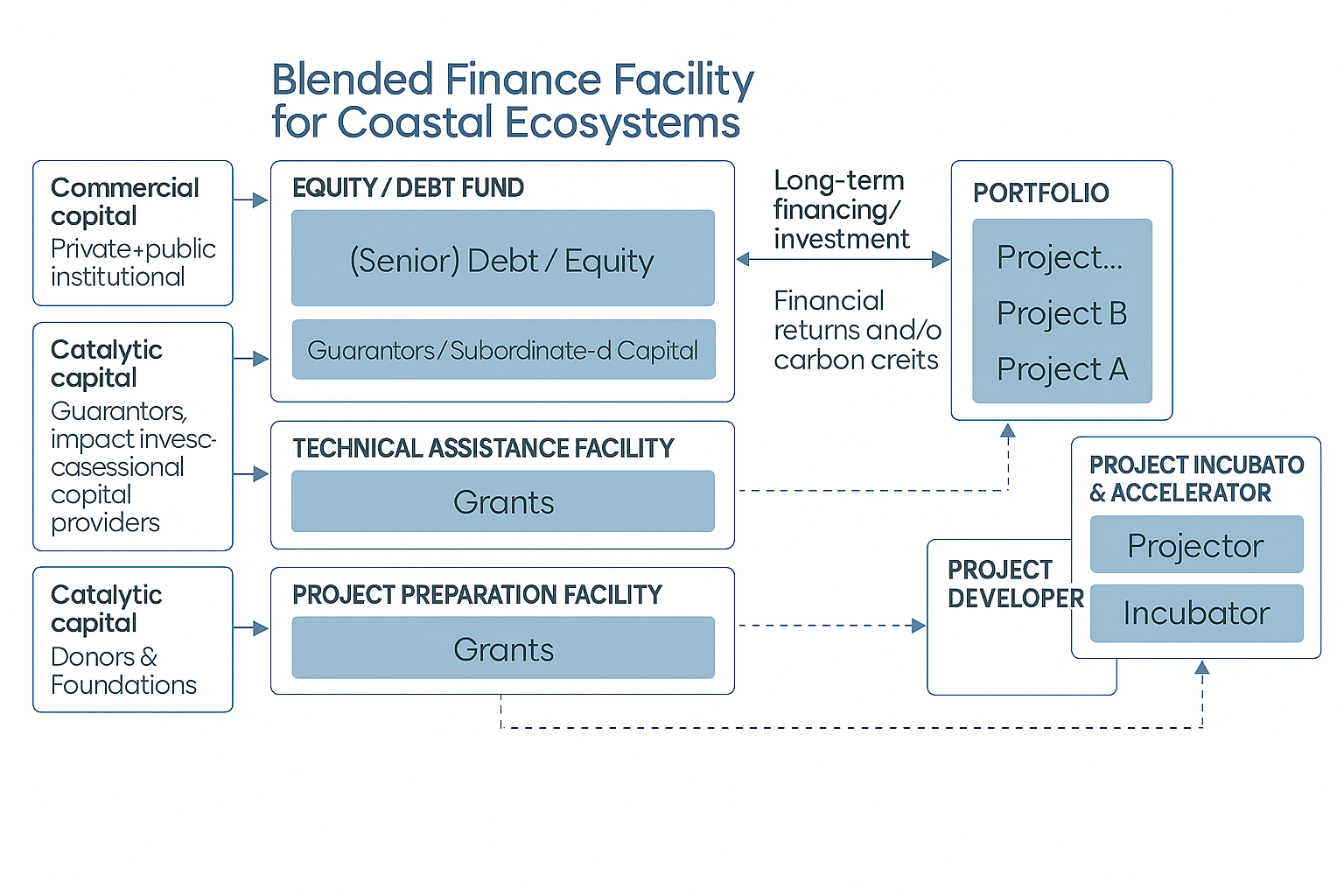
Under this structure, a portfolio of revenue‑generating projects within the Coral Triangle will be selected for financing based on their nature positive outcomes, such as reduced pollution, fishing pressure or carbon emissions. Selected projects will then receive catalytic capital in the form of grants or guarantees (like technical assistance and project preparation) to make them viable enough to generate returns and attract initial investment. Once sufficiently incubated, projects will then receive additional commercial capital for further incubation and scaling up.
Catalytic capital can come from philanthropic organisations, development banks or blended finance vehicles like the Dutch Fund for Climate and Development (DFCD). Commercial capital can come from private or public institutional investors or from investment funds like the Global Fund for Coral Reefs (GFCR). The GFCR in particular is a key source of finance for nature positive bankable projects in the Coral Triangle, so obtaining its support is crucial to the success of any such project. On behalf of participating partners (e.g. NGOs, government agencies), Seneca would set up an incubator –funded with grant capital– to provide information, technical assistance and capital to projects during their early formation.
Potential Projects
According to modelling, projects centred around addressing the causes of environmental degradation are among those with the most commercial potential in coastal ecosystems. With this in mind, Seneca has researched examples of profitable nature positive projects that could act as models for projects tackling the main threats to the Coral Triangle –pollution, overfishing and climate change.
At present, most of these projects are in the early stages of development, requiring startup investments within the range of US$250,000 – US$500,000. As this is likely to be too small to attract commercial investment capital, Seneca aims to set up a facility to provide these amounts of funding in partnership with other groups.
Here are some of the projects:
Converting Sewage to Compost
Corals in Southeast Asia are disproportionately affected by water pollution, which threatens 45% of the region’s reefs. Sewage forms a major component of this pollution and sanitation facilities in many Coral Triangle countries are often poor, making improving sewage management a key target for conserving reefs.
One way of doing this is to convert sewage into compost for agricultural use, thereby preventing it from ever reaching the sea at all. In Ghana, the Fortifer™ production plant was established with a US$650,000 investment (excluding land costs) via a public-private partnership between the waste management company, Jekora Ventures and various public entities including the International Water Management Institute. The plant now absorbs 12,500 m³ of fecal sludge (along with 700 metric tonnes of other organic waste) per year, reducing pollution from untreated waste disposal and producing 500 metric tonnes of high-quality compost per year.
Such a venture would easily be replicable and scalable in Coral Triangle countries. Doing so would not only stem a major source of marine pollution, but could also generate financial benefits for local people and investors through compost sales, job creation at plants, and possibly also user fees for waste disposal. Enhanced crop fertilisation enabled by increased compost availability could also increase food security, potentially reducing the need for fishing and alleviating pressure on fish stocks.
Recycling Wastewater for Aquaculture
As well as sewage, wastewater is also a considerable pollution threat to coral reefs, often being laden with fertilisers and organic compounds that cause toxic algal blooms. However, this nutrient rich water could instead be redirected to other uses, including land-based aquaculture via the use of waste stabilisation ponds.
In some countries, wastewater is pumped into a series of natural or human-made ponds (waste stabilisation ponds) and left in each successive one for several days to degrade organic waste and reduce pathogen loads, through a combination of bacterial processes and exposure to sunlight. By the time it reaches the latter ponds, it should be well-treated enough and retain sufficient nutrients to safely raise fish, ducks or aquatic plants.
Wastewater-fed aquaculture is already used in several countries in Asia and Africa, producing anywhere from 3,900 to 30,000 tonnes of fish annually. Moreover, a case study in Ghana found that when introduced at the right size, fish in waste stabilisation ponds not only had an 80% survival rate, but could grow from 62 grams to a kilogram in just 6 months. These high volumes and rapid rates of production can easily generate enough capital to cover costs and provide returns for investors, as the use of natural processes instead of machinery mean that operational costs are extremely minimal. Land costs however may be more significant, as waste stabilisation ponds require large areas to treat waste or produce aquaculture products on a meaningful scale.
Seaweed Farming
Seaweed farming is already a well-established industry in the Coral Triangle, with Indonesia and the Philippines being among the top 5 producers in the world. It is also a highly lucrative industry worth US$15 billion in 2021, with a wide range of commercial applications including in animal feed and direct human consumption. Markets for seaweed are expected to grow further, with a 2023 report by the World Bank finding that new seaweed applications (e.g. pharmaceuticals, bioplastics) could be worth an additional US$11 billion by 2030.
Investing in expanding seaweed farming in the Coral Triangle makes good business sense given the pre-existence of seaweed farming infrastructure in the region, and the existence and emergence of profitable seaweed markets globally. It also represents an excellent nature-based solution for many of the Coral Triangle’s environmental problems. Seaweed can provide local communities with an alternative source of income to fishing, as well as food and habitat for fish themselves, potentially helping stocks to recover from overfishing. Seaweed can also absorb nutrients like ammonia, helping to reduce nutrient pollution and the resulting algal blooms.
Moreover, as seaweeds globally are estimated to absorb nearly 200 million tonnes of carbon per year, seaweed farming could also help to reduce the impacts of climate change on the Coral Triangle, and potentially generate further revenue in the form of blue carbon credits. That said, recent research has cautioned against relying too heavily on seaweed farming as a carbon sequestration measure over feasibility concerns.
Sea Cucumber Farming
Being a popular delicacy in Chinese cuisine, with tropical species fetching up to US$600 per kilo in Hong Kong and Mainland China, sea cucumbers have been heavily fished worldwide, causing severe declines in many populations due to poor management. This is particularly true of the Coral Triangle, which not only has a very large number of threatened sea cucumber species, but also some of the highest exploitation rates in the world.
With wild populations at risk of collapse, aquaculture has recently emerged as a means to alleviate pressure on them. Despite being a relatively young niche market, sea cucumber aquaculture nonetheless has significant commercial potential. With the high selling prices and volumes of sea cucumbers produced –90,000 tonnes per year in China alone– aquaculture represents a potentially lucrative industry for both investors and farmers. Furthermore, the Coral Triangle’s long history of sea cucumber fishing makes aquaculture highly replicable there.
As a conservation tool, sea cucumber aquaculture could potentially serve as a source for reintroductions to the wild (similar to Seneca’s sturgeon aquaculture project). This in turn would help reduce climate pressures on coral reefs, as sea cucumbers have been found to increase the alkalinity of surrounding sea water through their feeding activities, buffering the impacts of ocean acidification. Additionally, raising sea cucumbers alongside other commercial species could reduce the nutrient pollution commonly associated with aquaculture, as they feed on the waste of those other species.
Coral Restoration on Wind Turbines
In a warming world, wind turbines could offer salvation both to us and to corals. Being installed in relatively deep offshore waters, they are less exposed to the extremes in marine heating that shallower habitats are increasingly experiencing due to climate change.
Enter ReCoral, a proof-of-concept project by Danish renewable energy company, Ørsted, to install corals on the foundations of wind turbines at the Greater Changhua offshore wind farm in Taiwan. In partnership with the Penghu Marine Biology Research Centre, ReCoral has already seeded thousands of coral larvae on part of a wind turbine in specially designed mesh cages. If successful, Ørsted hopes to replicate this project in other locations.
Investing in ReCoral –which would provide returns in the form of wind energy sales– would allow it to scale up its coral restoration efforts, possibly extending to the Coral Triangle itself. The mesh cages used in seeding corals on wind turbines could just as easily be attached to other deep-water structures. Moreover, corals that mature on these structures will then release their spawn into the water to potentially be carried elsewhere by ocean currents, aiding the restoration of corals beyond the immediate vicinity and boosting genetic connectivity between them. Thus, investments in ReCoral could potentially enable coral restoration on a wide geographic scale, as well as further wind energy expansion.
This insight is part of Seneca Impact Advisors’ work supporting the development of investable, nature‑positive projects.
For more information, contact impact@senecaimpact.earth